Strategy & development Perspectives 04
Colombian urea for agricultural growth
The strategic case for turning local coal into fertilizer
Download PDFEnglish · 0.6 MB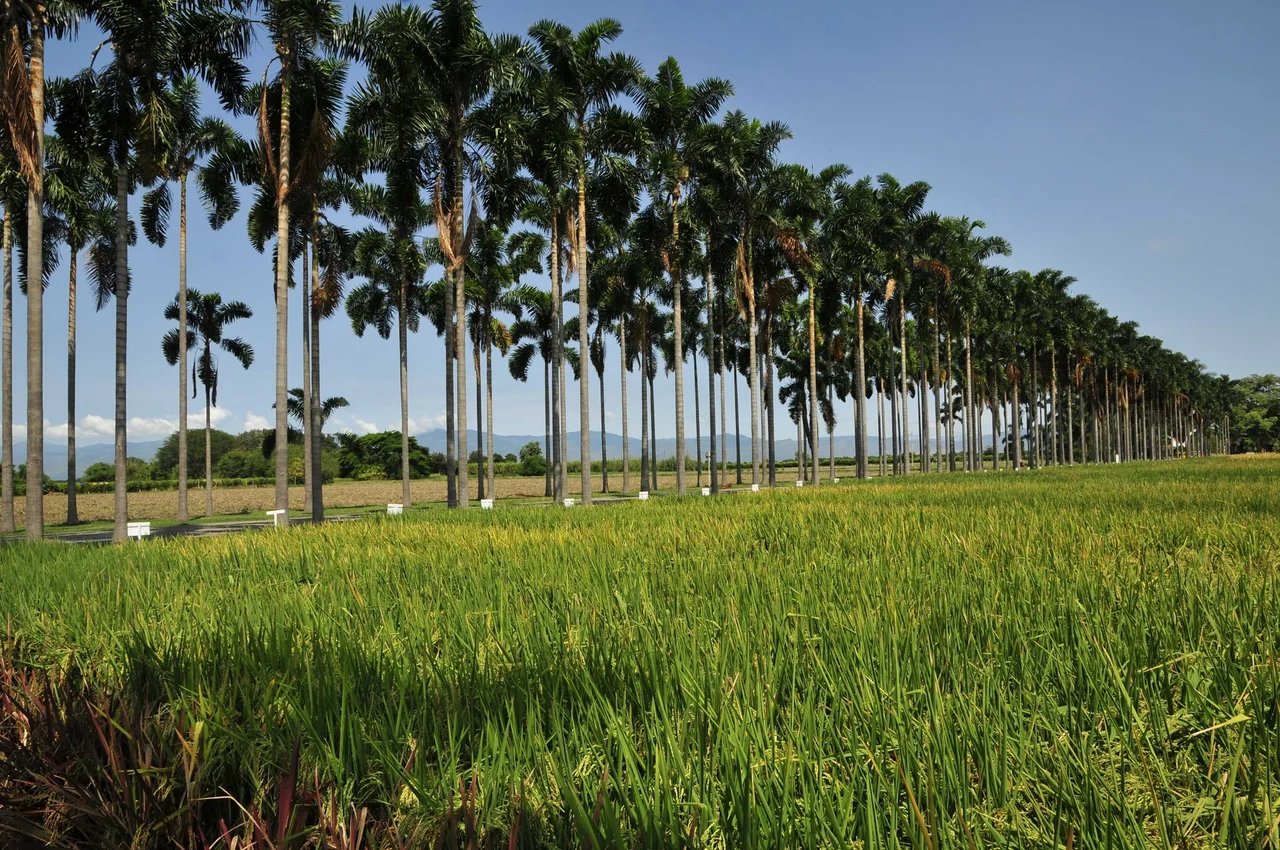
Key takeaways
- USD 228 million in urea imports in 2024; HS 310210.
- Meta: 2.4 million hectares suitable for mechanized maize, not new land ready for planting.
- The strategic contribution is to reduce agricultural vulnerabilities; no inflation effect is quantified.
C&ENER · Perspectives 04 · October 2026 · English edition 2.0
Agricultural expansion also needs an industrial base
Colombia imports urea and has coal that can be converted into the feedstock for that fertilizer. At the same time, it has regions with potential to expand agricultural output. Connecting these realities creates a concrete opportunity: developing an industry that turns national resources into an input for agricultural growth.
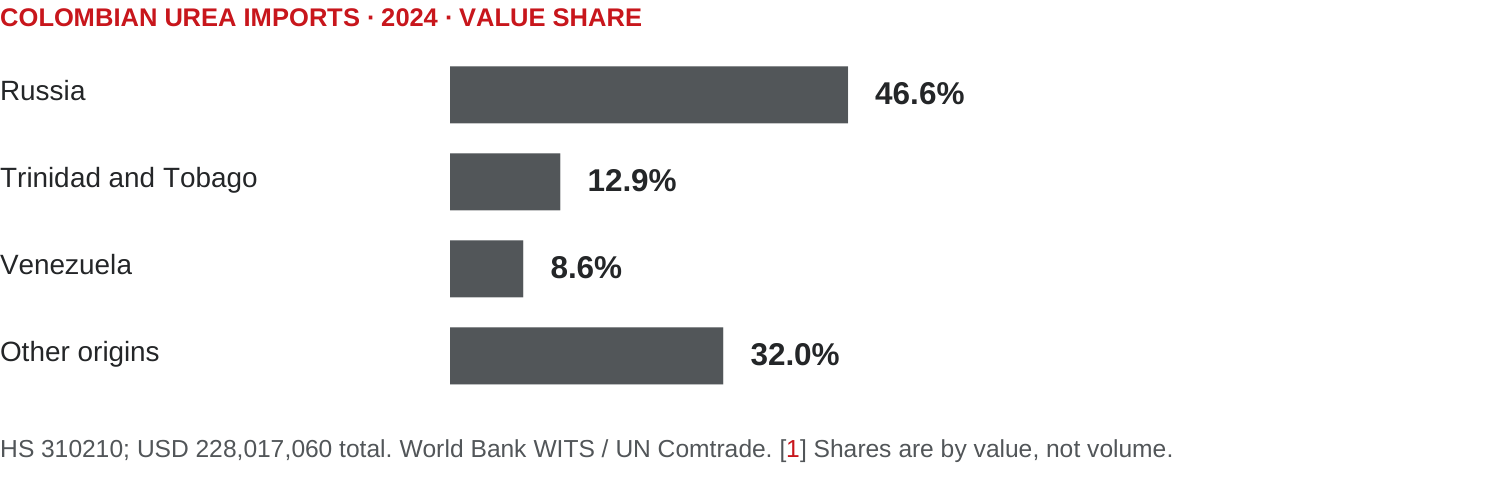
The scale is already visible. In 2024, Colombia imported USD 228 million of urea, according to WITS, the World Bank platform presenting UN Comtrade trade data. Russia accounted for approximately 47% of that value. [1] There is a recurring external purchase and a concentration that domestic supply would help diversify.
On the production side, UPRA identified 2.4 million hectares suitable for mechanized maize in Meta. [2] This is a suitability assessment, not new land immediately available for planting. Even so, it shows why larger-scale agriculture needs a discussion about its input supply.
That is this article’s thesis: producing urea from Colombian coal has strategic value because it connects an existing mineral resource base with agricultural demand and industrial capacity within the country. This provides an economic reason to develop the opportunity alongside assessing a plant’s financial return.
1. The Llanos need more than an agricultural ambition
Envisaging the Llanos at an agroindustrial scale comparable to Mato Grosso requires looking at the full chain. Increasing output needs suitable land, knowledge, financing and a network supplying seeds, crop nutrition, services and transport. Fertilizer is part of that productive infrastructure.
Meta offers a particularly useful reference. UPRA identifies not only 2.4 million hectares suitable for mechanized maize but also reports, using Fenalce data, that the department produced 511,000 tonnes of maize in 2022. Of this, 398,000 tonnes were mechanized yellow maize, representing 33.2% of national production of that type. [2] The discussion starts from a region that already produces and has identified suitability for that activity.
Urea supplies nitrogen. A domestic source of this nutrient can accompany agricultural expansion and intensification, working with distributors and producers that need availability during crop cycles. Application rates and other nutrients depend on soil and crop conditions; manufacturing urea addresses a specific part of that requirement rather than all of it.
For Colombia, the strategic connection is clear: developing agricultural capacity and input capacity in complementary ways. A plant does not create a new agroindustrial hub on its own, but it can form part of the foundation for sustained production at a larger scale.

2. Coal has a specific rationale in Colombia’s equation
The fertilizer industry often develops around the feedstock a country can supply competitively. The IEA links the positions of the United States, Russia and the Middle East to low-cost gas, and coal’s role in China to that resource’s abundance. In its 2020 reference year, about 85% of Chinese ammonia came from coal. [4] Feedstock selection reflects economic geography.
Colombia has a coal resource base that supports considering this industrial connection. ANM documents the gasification–hydrogen–ammonia–urea chain and identifies potential to obtain hydrogen from thermal coal, subject to feedstock characterization. [5] Gasifying coal and water produces the hydrogen needed for ammonia without using natural gas as its principal feedstock.
This alternative matters in the national energy context. ANH’s IRR 2025 reports a proved-reserves-to-production ratio for gas of 5.9 years. [3] This is not a depletion date: it is a dynamic indicator calculated from the period’s reserves and production. It does show why a major new industrial demand for gas needs a specific supply basis. The coal pathway allows fertilizer development without adding that direct demand for gas as feedstock.
The design must include the cost of managing carbon, water and waste. The IEA identifies higher emissions intensity for coal-based ammonia than for natural-gas-based production. [4] That management is part of the work needed to turn a resource advantage into an industrial operation that is competitive and environmentally viable.

3. An external purchase that can become domestic activity
The USD 228 million of urea imports recorded in 2024 indicate the scale of a market supplied from abroad. The code used is HS 310210, which includes urea in aqueous solution; the figure does not represent the whole fertilizer market or exclusively agricultural use. [1]
Russia accounted for 46.6% of import value. Together with Trinidad and Tobago and Venezuela, the three leading origins represented 68.0%. [1] This gives substance to autonomy: Colombian supply adds a source whose production process is located in the country and reduces the need to import the volume it actually replaces.
Domestic manufacturing also shifts some activity into a national chain: coal supply, chemical conversion, operations, maintenance, storage and distribution. Industrial value lies in connecting those activities to a product agriculture already buys. The benefit extends beyond opening a mine or installing a chemical unit in isolation.
Substitution has a concrete measure: domestic tonnes sold in place of imported tonnes. Its net foreign-exchange effect requires deducting external payments for equipment, inputs, services and financing. USD 228 million is a gross market reference rather than a promise of equivalent savings. The favorable argument remains substantial: there is an identifiable purchase around which to build local supply and productive activity.
Read figure description
COLOMBIAN UREA IMPORTS · 2024 · VALUE SHARE
Russia
46.6%
Trinidad and Tobago
12.9%
Venezuela
8.6%
Other origins
32.0%
HS 310210; USD 228,017,060 total. World Bank WITS / UN Comtrade. [1] Shares are by value, not volume.
4. Agricultural costs and inflation: where the contribution lies
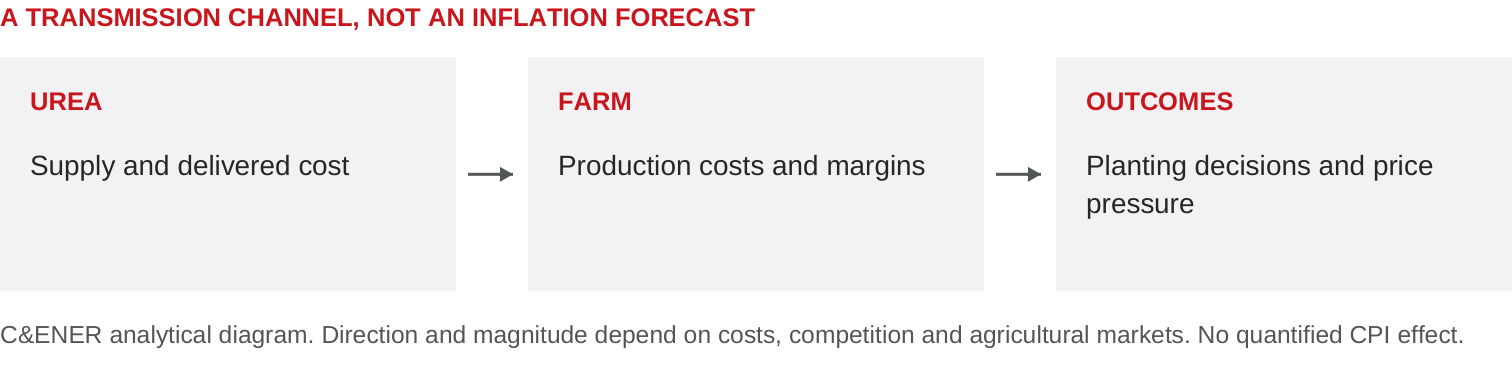
Fertilizers transmit movements in energy, trade and international logistics to farms. The World Bank documented this mechanism in 2022: gas and coal price increases, production cuts and trade restrictions put pressure on fertilizer prices and availability. [6] In Colombia, UPRA reported that fertilizer prices increased 38% in the first half of 2022. [7] Farmers face costs that can originate far from their fields.
A domestic industry supported by local feedstock can shorten that chain of exposure. Replacing imported urea removes the international logistics leg for the finished fertilizer and adds supply that can organize production, inventories and deliveries from Colombia. Integrating coal supply also allows planning and long-term agreements to address a central part of the process’s physical costs.
This is the connection with cost stability and food inflation: a more competitive and reliable input base helps contain a source of pressure on agricultural production. Its effect may appear in producer margins, planting capacity or reduced pressure on prices, depending on the crop and market conditions. Domestic production remains exposed to international references; a lower selling price requires competitive costs and effective competition.
The defensible contribution is reducing a cost and supply vulnerability in agriculture, rather than attributing a number of inflation points to one plant. That vulnerability is economic and affects the ability to produce food profitably.
Read figure description
A TRANSMISSION CHANNEL, NOT AN INFLATION FORECAST
UREA
Supply and delivered cost
FARM
Production costs and margins
OUTCOMES
Planting decisions and price
pressure
C&ENER analytical diagram. Direction and magnitude depend on costs, competition and agricultural markets. No quantified CPI effect.
5. Why this thesis supports an initiative such as C2U
C2U, the initiative C&ENER is developing around coal resources in Córdoba, sits at this intersection: a domestic feedstock, an established industrial conversion and an imported product used by agriculture. Its rationale is to integrate that chain and capture value in Colombia.
From the country’s perspective, three contributions justify developing the opportunity: diversifying urea supply, turning coal into industrial capacity connected to agriculture and supporting an agricultural sector that can grow. From the project’s perspective, these contributions define its intended market and economic role.
A location in Córdoba does not establish a delivered-cost advantage in the Llanos. That connection requires a commercial and logistics solution, as does serving other agricultural markets across Colombia. Meta’s potential illustrates productive demand that can develop; it is not presented as contracted demand for C2U.
Engineering and commercial structuring must turn this rationale into verifiable consumption, costs, output and sales. The reason to undertake that work already has substance: Colombia pays for imported urea, has coal that offers an industrial pathway and has an agricultural base with room to increase production.
Industrial capacity serving agricultural growth
Larger-scale agriculture needs an input network capable of supporting it. Producing urea from Colombian coal offers a way to connect that need with domestic resources and industrial activity.
A national discussion can start from three facts: an identifiable import bill, an agricultural region with demonstrated production and assessed suitability, and a technology capable of turning coal into fertilizer. That is the strategic foundation for developing an industry such as the one C2U proposes. Its concrete contribution will be measured in competitive product delivered to agriculture and productive capacity retained in Colombia.
Sources and scope
C&ENER is developing C2U and has a commercial interest in this discussion. The initiative’s location and rationale are company-provided editorial information, not feasibility results or endorsement by the cited institutions. The productive-development thesis is C&ENER analysis. No returns, guaranteed capacity, net foreign-exchange savings or estimated inflation effects are published.
Review date: 30 October 2026. Every indicator retains its year and denominator. Agricultural suitability does not mean new land available for cultivation; the reserves-to-production ratio is not a depletion date. The coal pathway must be assessed using the specific resource quality, costs and environmental performance of the proposed design.
[1] World Bank, WITS / UN Comtrade. Colombia, 2024 imports, HS 310210 (urea, including aqueous solution). World value: USD 228,017,060; Russia: USD 106,172,070; Trinidad and Tobago: USD 29,425,180; Venezuela: USD 19,543,020. Own value-share calculations: Russia 46.56%; leading three 68.04%. Aggregate world quantity is absent and is not imputed. https://wits.worldbank.org/trade/comtrade/en/country/COL/year/2024/tradeflow/Imports/partner/ALL/product/310210
[2] UPRA (28 November 2023). Presentation of the Maize Agricultural Production Conversion Plan for the Orinoquía in Villavicencio. Meta suitability: 2.4 million ha; 2022 maize output: 511,000 t; mechanized yellow maize: 398,000 t and 33.2% of national output of that type, citing Fenalce. https://upra.gov.co/es-co/sala-de-prensa/noticias/la-upra-presenta-en-villavicencio-el-plan-de-reconversion-productiva
[3] ANH. Resource and Reserves Report, IRR 2025. Pp.8 and 18: proved-gas-reserves-to-production ratio of 5.9 years, at 31 December 2025. A reserves/production quotient, not a depletion forecast or contractual availability statement. https://www.anh.gov.co/documents/34600/Informe_de_Recursos_y_Reservas_-_IRR_2025_XHILahu.pdf
[4] IEA (2021). Ammonia Technology Roadmap. P.9: feedstock geography and coal’s share of Chinese ammonia, reference year 2020; p.34: gasification and higher emissions intensity than natural gas. https://iea.blob.core.windows.net/assets/6ee41bb9-8e81-4b64-8701-2acc064ff6e4/AmmoniaTechnologyRoadmap.pdf
[5] ANM. Non-conventional uses of coal in Colombia in a decarbonization context. Table 2, p.39; §3.4.5, pp.97–98. Portal: July 2026; internal version date: 22 December 2025. Potential and feedstock characterization requirements, not proof of C2U feasibility. https://saportalanm.blob.core.windows.net/public-files/2026-07/Carb%C3%B3n%20-%20julio%202026.pdf
[6] World Bank. Baffes and Koh (11 May 2022). Fertilizer prices expected to remain higher for longer. Uses observed transmission mechanisms from energy, production and trade, rather than the forecast made at that date. https://blogs.worldbank.org/en/opendata/fertilizer-prices-expected-remain-higher-longer
[7] UPRA (25 August 2023). Cauca farmers improve fertilizer profitability in potato production. Reports a 38% increase for the fertilizer group in the first half of 2022, based on its Agricultural Input Price Bulletin. Not food inflation or a urea-only price change. https://upra.gov.co/es-co/sala-de-prensa/noticias/productores-del-cauca-mejoran-la-rentabilidad-de-los-fertilizantes-en-el
Photograph: rice at CIAT, Colombia. Neil Palmer / CIAT, Rice 18 lo (5038157502), CC BY-SA 2.0. Editorial crop; not evidence of project outcomes. https://commons.wikimedia.org/wiki/File:Rice_18_lo_(5038157502).jpg https://creativecommons.org/licenses/by-sa/2.0/
Perspectives 04
The full analysis, also as a PDF.
Keep the publication with its figures, references and scope.