Industrial transformation Perspectives 02
From coal to urea: how the industrial chain works
The journey from a mineral resource to a fertilizer passes through several plants operating as one. Understanding their connections offers a clearer view of a potential industry in Colombia.
Download PDFEnglish · 0.5 MB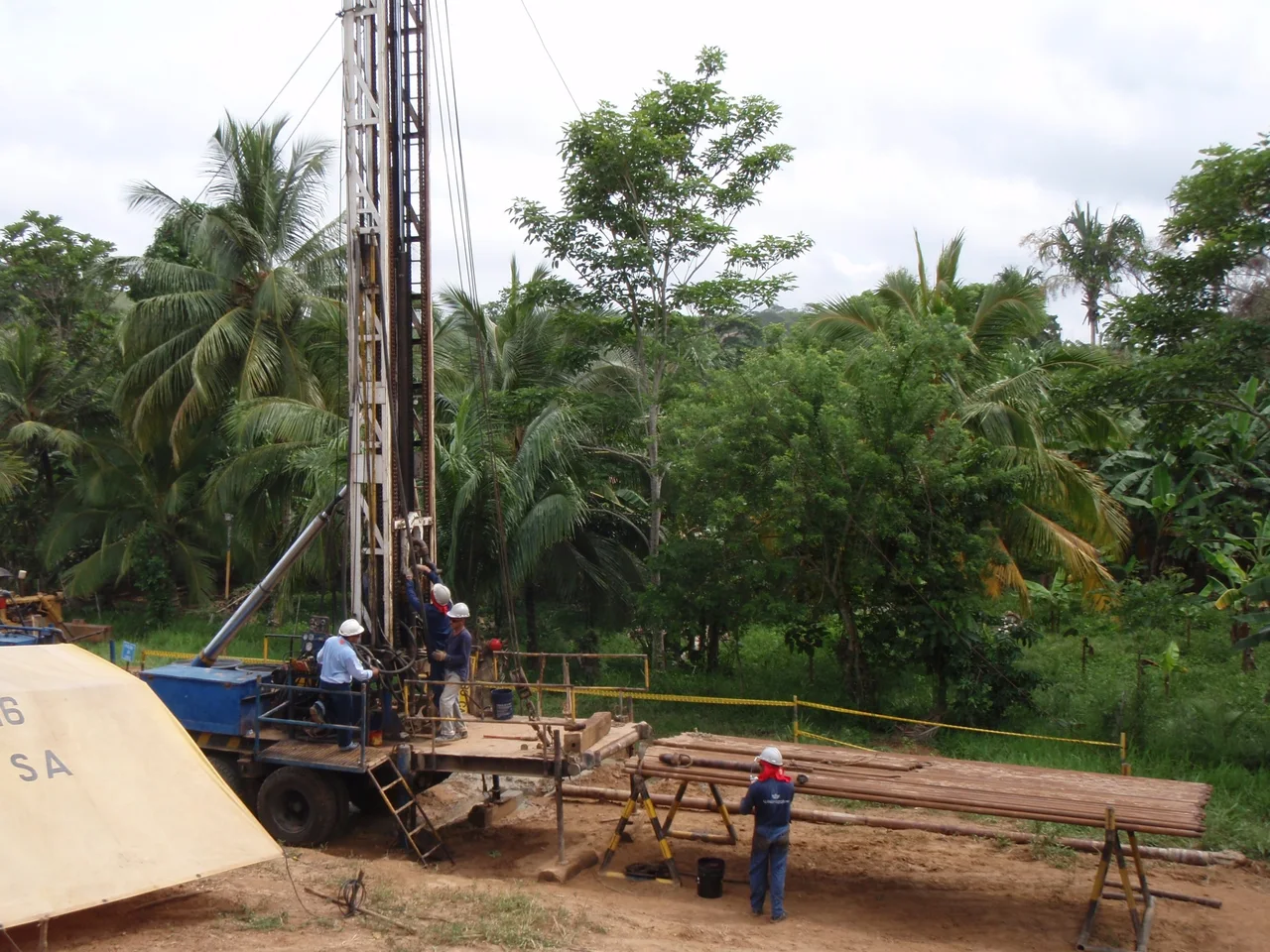
Key takeaways
- Coal is first transformed into synthesis gas.
- Ammonia comes before urea; finishing gives the solid product its form.
- Utilities and joint availability determine how the complex operates.
C&ENER · Perspectives 02 · October 2026 · English edition 1.0 · Based on approved Spanish edition 1.0
A bag of fertilizer begins long before the farm
In the field, the visible product is a granule. Behind it are treated water, air separated into its components, gases that are cleaned and equipment operating under pressure. Producing urea means coordinating all those operations to deliver a product that farmers can transport, store and apply.
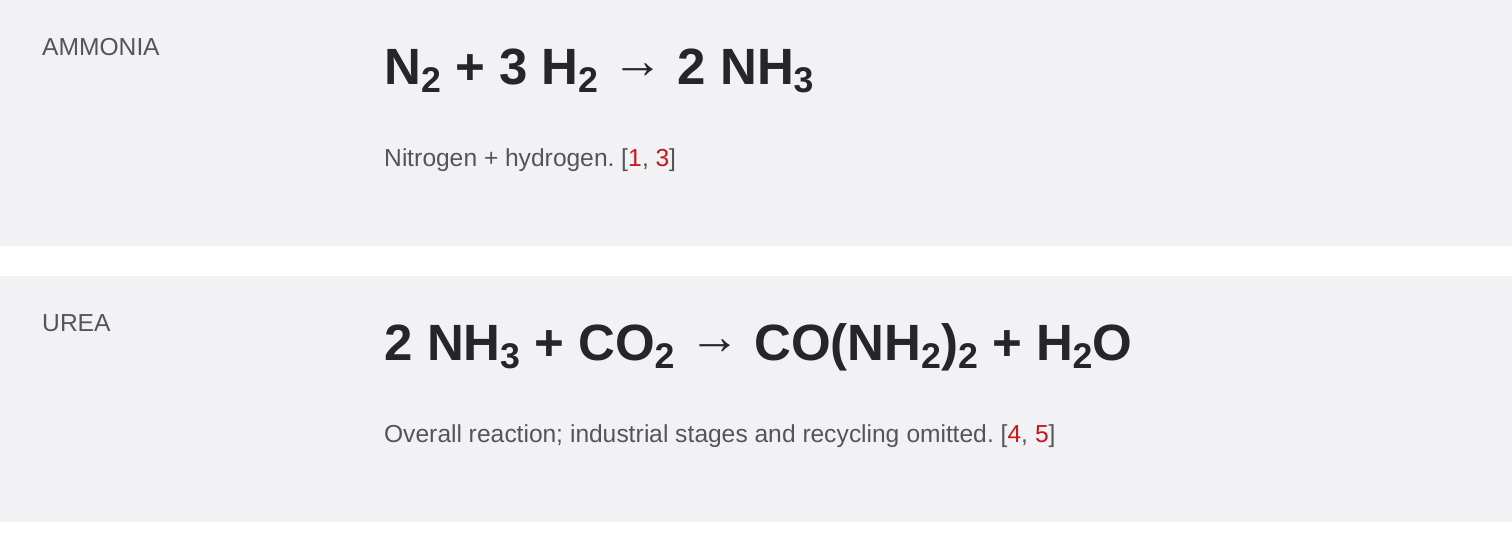
Urea supplies nitrogen, one of the nutrients plants need to grow. It is manufactured by combining ammonia and carbon dioxide. Ammonia, in turn, comes from nitrogen and hydrogen. The industrial question arises one step earlier: where does the hydrogen come from? Coal gasification provides one answer already used in industry. [1,2]
The first article in this series opened the discussion about Colombia’s possibilities. This second article follows the process from the inside: what is transformed, what must be separated and why a coal reserve is only the beginning of the chain.
Thinking of a single factory is of limited help. It is more useful to imagine a group of connected plants: one prepares the feedstock, another produces gases, another purifies them, and the following units turn them into ammonia and urea. Their connections matter as much as their equipment.
1. Coal changes form
The first transformation occurs in the gasifier. Coal reacts at high temperature with oxygen and water in the form of steam, depending on the chosen configuration. The result is synthesis gas: a mixture containing hydrogen, carbon monoxide, carbon dioxide and other components. This gas is an intermediate feedstock; it is still a long way from fertilizer. [1,2]
Oxygen is supplied through air separation. Its use helps control the transformation of coal and the composition of the resulting gas. The design must also address coal feeding, heat recovery and removal of mineral material remaining as solid residues. [1,2]
Resource quality matters greatly here. Two coals sold under the same commercial classification may behave differently in a gasifier. Moisture, minerals and compounds that must be removed from the gas change preparation and treatment requirements. A figure for available tonnes therefore cannot replace characterization of the material that will actually be fed into the process. [1,2]
For Colombia, the useful question is specific: how does this coal, from this deposit, perform in the technology being considered? The answer is built from representative samples, analysis and the technology provider’s criteria. This is the bridge between understanding a resource and designing a facility.
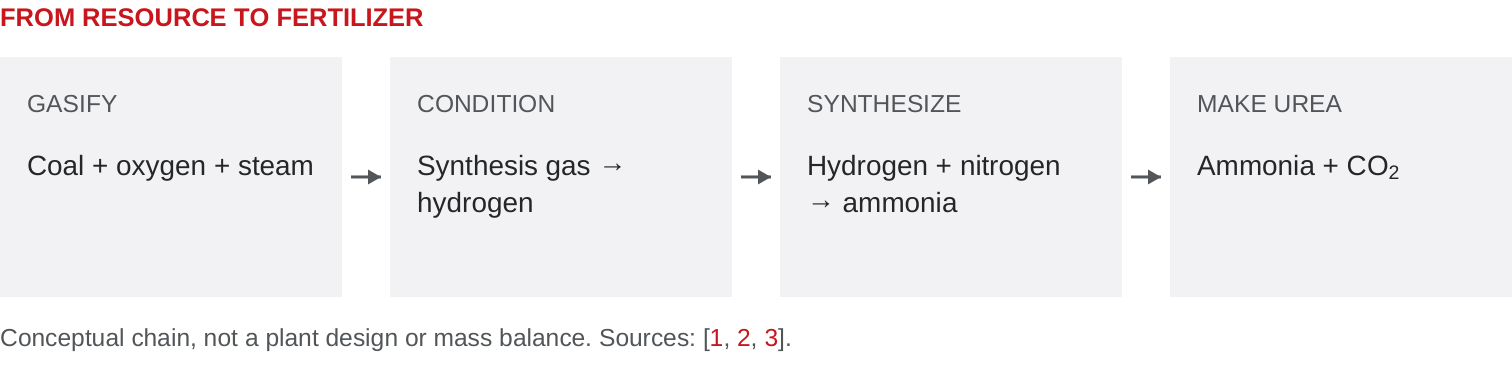
Read figure description
FROM RESOURCE TO FERTILIZER
GASIFY
Coal + oxygen + steam
CONDITION
Synthesis gas →
hydrogen
SYNTHESIZE
Hydrogen + nitrogen
→ ammonia
MAKE UREA
Ammonia + CO2
Conceptual chain, not a plant design or mass balance. Sources: [1, 2, 3].
2. Gas must become a reliable feed
Leaving the gasifier begins another stage. The catalysts used to make ammonia require a feed meeting specific conditions and purity requirements. A catalyst accelerates a chemical reaction; certain contaminants can reduce its activity or damage it. Cleaning the gas protects the heart of the plant. [1]
Alongside removing impurities, the process must increase hydrogen availability. A fundamental reaction combines carbon monoxide with steam to form carbon dioxide and hydrogen. It is known as the water-gas shift reaction. Water participates in the chemistry: it also supplies hydrogen to the process. [1,2]
CO₂ is then separated and the stream is conditioned for subsequent stages. The precise order of cleaning, shift conversion and separation depends on the design. A simple diagram explains each step’s function; engineering defines its sequence, equipment and operating conditions. [1,2]
This helps explain why integration requires care. Each stream must reach the next unit with the composition, pressure and temperature that unit needs. Dakota Gasification’s commercial operation provides a specific example: its ammonia chain includes shift conversion, CO₂ separation, final treatment and gas recycling. Not every plant uses exactly that configuration. [3]
Read figure description
WATER-GAS SHIFT
CO + H2O → CO2 + H2
Carbon monoxide + water → carbon dioxide + hydrogen. [1, 2]
3. Ammonia first; then urea
Once hydrogen is prepared, nitrogen enters the picture. It comes from air: a stream must supply it at the quality required by the process. Hydrogen and nitrogen react under pressure, aided by a catalyst, to produce ammonia. Unreacted gases are recovered and recirculated within the loop. [1,3]
Ammonia is an industrial product in its own right and also the feedstock for urea. In the next unit, it combines with CO₂. The overall reaction forms urea and water; industrially, it includes stages and material recovery that the simplified chemical equation does not show. Dakota documents this integration: it uses ammonia and CO₂ produced at its complex to manufacture urea. [4]
Urea must then be brought into the form in which it will be sold. For solid fertilizers, this includes concentrating the solution and forming particles using a finishing technology such as granulation or prilling. Handling and storage are part of the product ultimately received by the buyer. [5]
This distinction helps interpret a project: a unit that blends or conditions fertilizers serves a different purpose from a complex that synthesizes their molecules. In the integrated coal pathway, the chemical chain starts long before the granule appears.
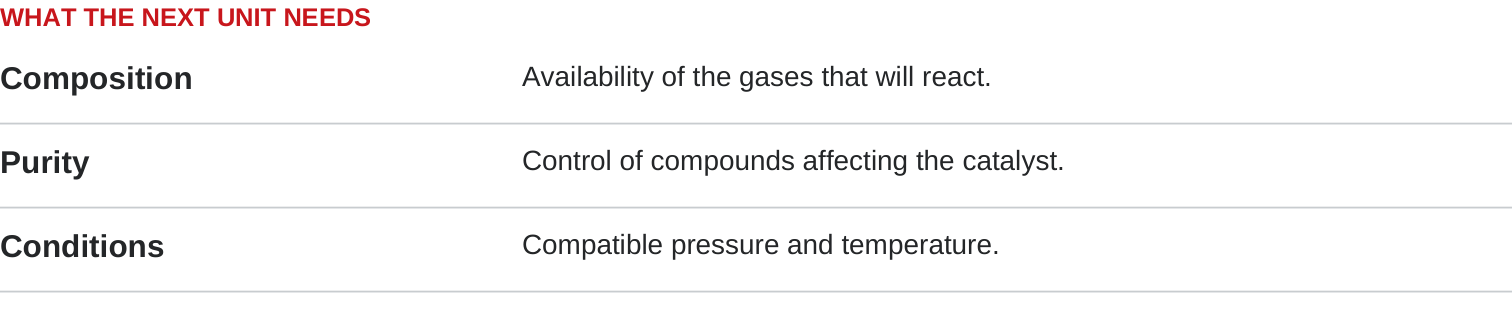
Read figure description
WHAT THE NEXT UNIT NEEDS
Composition
Availability of the gases that will react.
Purity
Control of compounds affecting the catalyst.
Conditions
Compatible pressure and temperature.
4. CO₂ connects two units and opens another account
In this pathway, separating CO₂ helps prepare the gas for ammonia production. Some of that CO₂ can feed urea manufacturing if it meets the required specifications. This creates a valuable industrial connection: a stream obtained while conditioning the gas becomes an input to another unit. [1,4]
The overall reaction provides a reference for understanding quantities: one tonne of pure urea theoretically requires about 567 kg of ammonia and 733 kg of CO₂, and forms about 300 kg of water. These masses are calculated from the chemical equation. They are not guaranteed plant consumption figures, and exclude energy, utilities, losses and internally circulating streams.
The carbon balance requires a broader view. CO₂ incorporated into urea must be distinguished from CO₂ in other streams throughout the complex, including those associated with energy supply. The IEA notes that coal-based production is more emissions-intensive than natural-gas-based production; using CO₂ as a urea feedstock does not by itself resolve that difference. [1]
The final destination also matters. The IPCC accounts for release of the carbon in urea after its application to soil. Incorporating CO₂ into this fertilizer therefore does not amount to permanent storage. Assessing a project requires a complete balance and decisions on treatment, other uses, emissions and, where considered, geological storage. [6]

Read figure description
IDEAL MASS BALANCE PER 1,000 KG OF PURE UREA
INPUTS
≈567 kg ammonia + ≈733 kg CO2
OUTPUTS
1,000 kg urea + ≈300 kg water
5. Connected plants also share their constraints
Chemical reactions sit at the center of the diagram, surrounded by the services that make them possible: treated water, steam, electricity, cooling and management of residual streams. Gasification and ammonia production require energy and auxiliary equipment; their integration determines how heat and materials circulate within the complex. [1,2]
Water deserves particular attention. It participates in hydrogen production and can also provide cooling and steam-generation services. These are different uses, with different quality and recovery requirements. A site assessment must distinguish withdrawal, recirculation, consumption and discharge; adding all flows passing through equipment can overstate demand for fresh water.
The same logic applies to solids and compounds removed from the gas. The design must identify what is generated, its characteristics and its destination. Coal composition and the selected technology change the answers. For a Colombian project, water availability, power supply and environmental infrastructure are location and design questions from the outset.
Finally, the units must work together. If hydrogen supply is interrupted, ammonia synthesis loses its feed; if ammonia or usable CO₂ is unavailable, urea output is constrained. Storage, maintenance and backup strategies can provide flexibility. Their scope must be designed: each unit’s nameplate capacity does not establish how many tonnes the integrated complex will sell in a year.
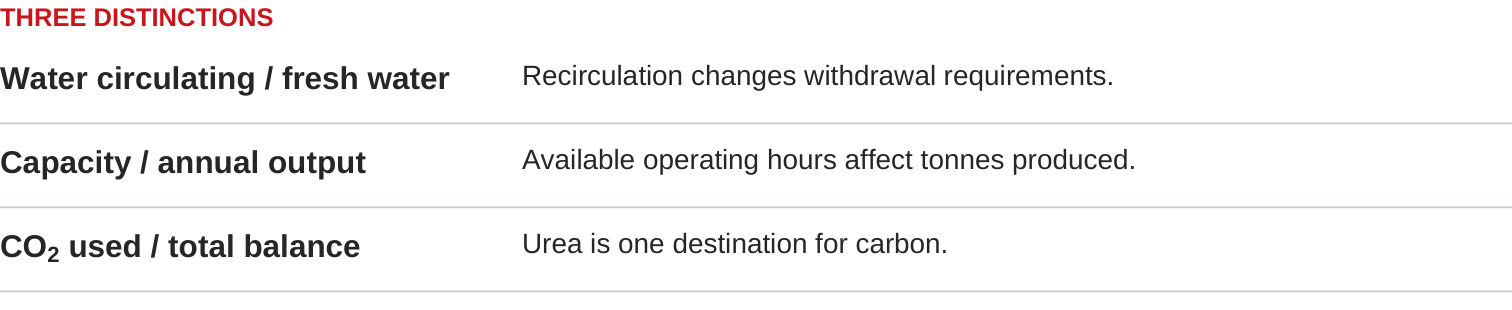
Read figure description
THREE DISTINCTIONS
Water circulating / fresh water
Recirculation changes withdrawal requirements.
Capacity / annual output
Available operating hours affect tonnes produced.
CO2 used / total balance
Urea is one destination for carbon.
What this journey helps us ask
A project becomes easier to understand when it can explain what enters each unit, what leaves it and how its services connect. That description reveals decisions omitted by a reserve figure or a four-arrow diagram.
For Colombia, the next technical step is to connect characterized coal with an industrial configuration, a site and its supplies. This produces mass and energy balances and a basis for estimating output, availability and environmental performance. These inputs allow alternatives to be compared on a consistent basis.
The technology has industrial precedents. The local opportunity depends on how a particular facility is designed and operated. The third article in this series takes that discussion to the buyer’s economics: what would have to happen for Colombian-produced urea to compete with imports, delivered to the same destination under comparable terms?
Sources and scope
An industrial explainer based on institutional sources and documentation from operators and technology providers. Research cut-off: 30 October 2026. Diagrams are conceptual; they do not represent engineering, capacity or performance of the C2U project.
C&ENER promotes exploration of industrial opportunities linked to Colombian resources, including C2U. This interest is disclosed so readers can distinguish public analysis from an independent feasibility assessment. Project balances and design decisions require specific studies.
[1] IEA (2021). Ammonia Technology Roadmap, pp.28–34: ammonia synthesis, gasification, purification, energy and emissions. https://iea.blob.core.windows.net/assets/6ee41bb9-8e81-4b64-8701-2acc064ff6e4/AmmoniaTechnologyRoadmap.pdf
[2] IRENA and Ammonia Energy Association (2022). Innovation Outlook: Renewable Ammonia, pp.34–36: conventional production and synthesis-gas preparation. https://www.irena.org/-/media/Files/IRENA/Agency/Publication/2022/May/IRENA_Innovation_Outlook_Ammonia_2022.pdf
[3] Dakota Gasification Company. Ammonia process: shift conversion, CO₂ removal, treatment, synthesis and recycling in its own configuration. Reviewed 30 October 2026. https://www.dakotagas.com/about-us/gasification/ammonia-process.html
[4] Dakota Gasification Company. Urea: integration of ammonia and CO₂ produced at the complex; urea production since January 2018. Reviewed 30 October 2026. https://www.dakotagas.com/products/fertilizers/urea.html
[5] Stamicarbon. Launch, Melt Technologies and Finishing Technologies: synthesis and finishing by granulation, prilling and pastillation. Reviewed 30 October 2026. https://www.stamicarbon.com/our-business/nx-stami-urea/launch
[6] IPCC (2006). Guidelines, vol.4, chapter 11, §11.4, p.11.32: CO₂ emissions from applying urea. https://www.ipcc-nggip.iges.or.jp/public/2006gl/pdf/4_Volume4/V4_11_Ch11_N2O%26CO2.pdf
Opening photograph: fieldwork in Córdoba. C&ENER archive, 2025 presentation. Not a urea plant or evidence of C2U’s current status.
Diagrams and calculation: C&ENER, based on the cited sources. Ideal chemical balance with rounded molar masses: 2 × 17 + 44 = 60 + 18. Per tonne of pure urea: 34/60 t NH₃ + 44/60 t CO₂ → 1 t urea + 18/60 t water. Not a plant mass balance.
Perspectives 02
The full analysis, also as a PDF.
Keep the publication with its figures, references and scope.